
How to Select Valves for High Temperature Steam Service: Engineering Guide
TABLE OF CONTENTS
Valve selection for high temperature steam service — ASTM material grades, ASME B16.34 pressure class, Stellite trim, Cv sizing, and specification mistakes explained for engineers and procurement teams.
High-temperature steam is one of the most unforgiving service environments for industrial valves. At operating temperatures above 400°C and pressures exceeding 100 bar, the difference between a correctly specified valve and an incorrectly specified one shows up as seat leakage within months, thermal cracking after the first major startup cycle, or catastrophic failure during a pressure transient.
This guide covers the full valve selection process for high-temperature steam service — from operating data collection through material selection, pressure class verification, trim specification, and the most common errors that cause early failure.
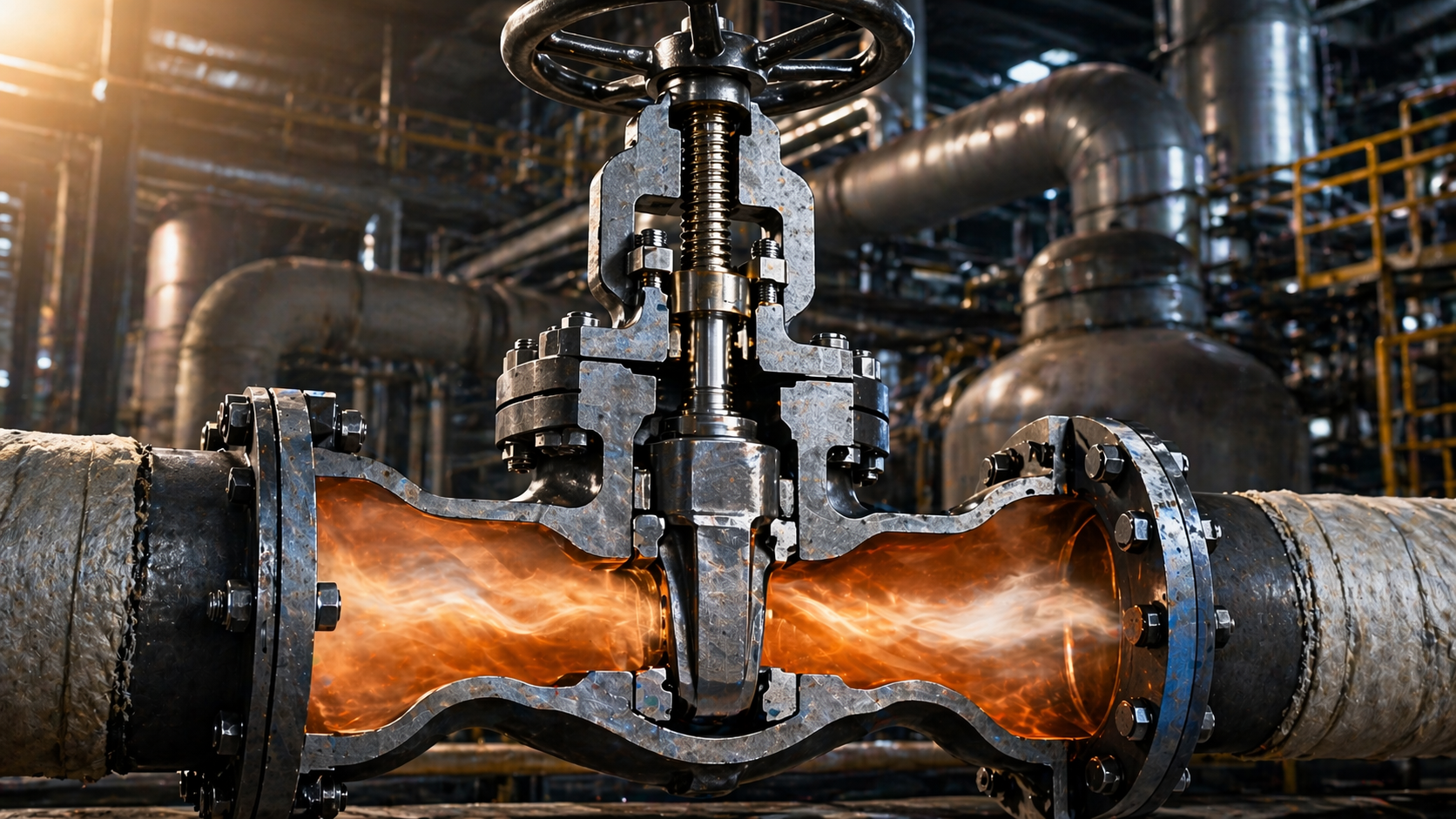
Why High-Temperature Steam Demands a Different Selection Approach
Most fluid services allow some margin for error in valve specification. High-temperature steam does not. Three factors make it uniquely demanding:
Creep. Above approximately 370°C, carbon steel begins to deform slowly under sustained mechanical load — a phenomenon called creep. A valve body that is correctly rated at ambient temperature may be overstressed at elevated temperature if the material grade is wrong. Creep failure is gradual and often invisible until a joint or body wall reaches critical wall loss.
Thermal cycling fatigue. Every startup and shutdown cycle creates thermal expansion and contraction in the valve body, bonnet bolting, and internal trim. Over thousands of cycles, this accumulates as fatigue damage at stress concentration points — flange necks, bonnet joints, and seat ring interfaces.
Erosion from high-velocity steam. Superheated steam at high velocity carries enough kinetic energy to erode unprotected seating surfaces within a single operating season if trim materials are not correctly specified.
These three mechanisms drive every material, trim, and design decision in the sections below.
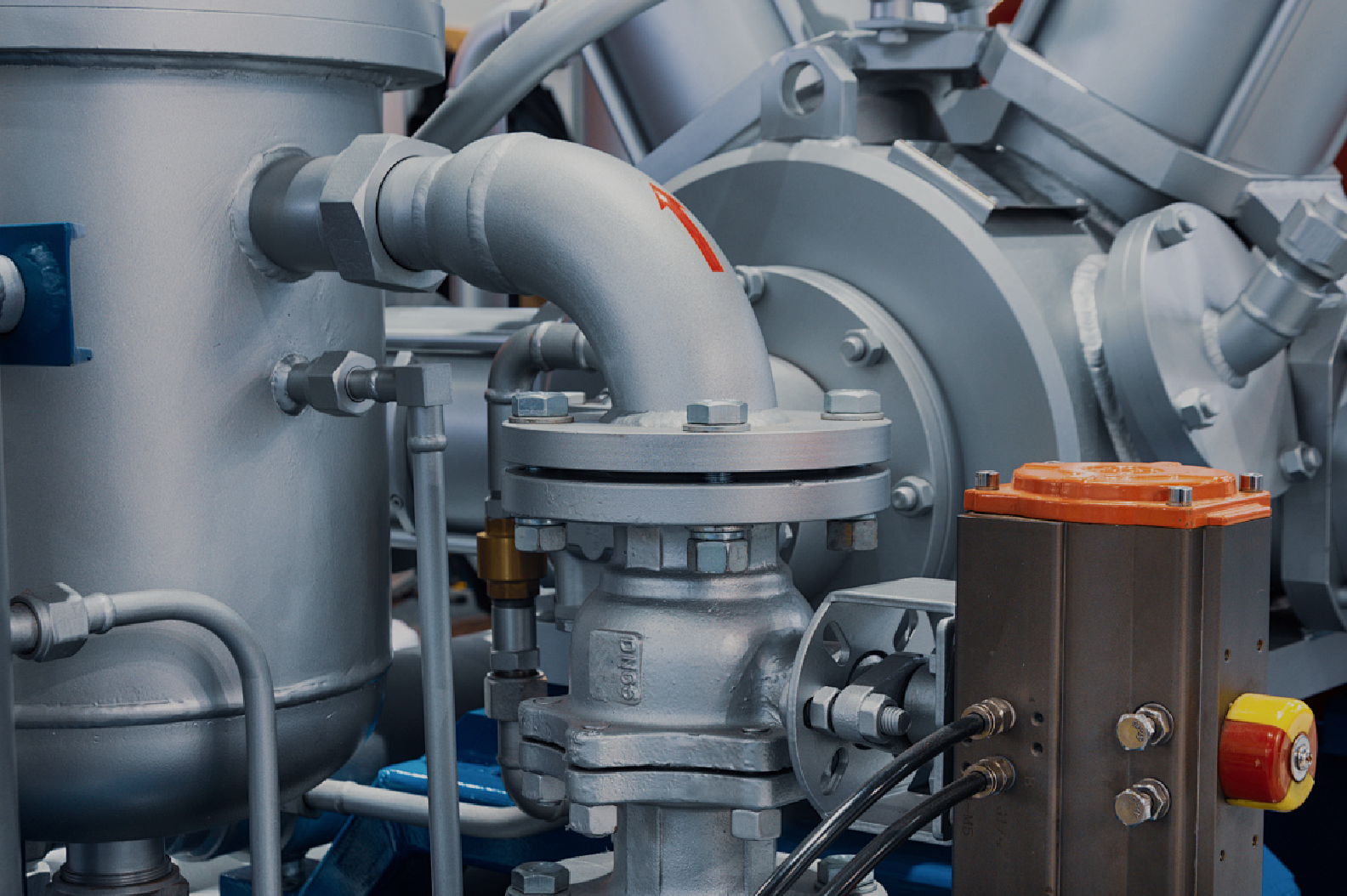
Step 1: Define Operating Conditions — The Data You Need Before Specifying Anything
Valve selection without complete operating data produces incomplete specifications. The minimum dataset required:
- Normal operating temperature and maximum design temperature (°C)
- Operating pressure and design pressure (bar g or psi g)
- Steam condition — superheated (specify superheat temperature and pressure), saturated, or wet steam with moisture content
- Valve function — isolation (on/off), regulation (throttling), or non-return
- Operation frequency — continuous service, occasional isolation, or frequent cycling
- Flow rate — required for control valve Cv calculation and for check valve sizing
A valve specified for 300°C saturated steam at 40 bar is a fundamentally different product to one specified for 540°C superheated steam at 140 bar — even if the line size is identical. Both decisions flow from this data.
Step 2: Valve Type Selection by Function
Valve type follows function. In high-temperature steam systems, using the wrong valve type for the application is the most common source of premature failure.
Gate Valves — Isolation Service
Gate valves are designed for full open or full closed service on main steam headers, boiler outlet lines, and turbine inlet isolation. They provide full-bore flow with minimal pressure drop in the open position.
Gate valves must not be used for throttling. When partially open, high-velocity steam passes across the exposed wedge face and seat rings at high velocity — a process called wire drawing — that erodes seating surfaces rapidly and destroys shutoff capability. A gate valve used for throttling typically requires seat replacement within one operating season.
Globe Valves — Throttling and Regulation
Globe valves are the correct choice where flow needs to be regulated rather than simply isolated. Their disc-to-seat geometry is designed to handle partial opening under flow, making them suitable for boiler feed water control lines, desuperheater inlet regulation, and high-pressure steam bypass systems.
For high-temperature service, globe valves should be specified with Stellite-hardfaced seats and discs, and graphite stem packing. Standard stainless steel trim degrades under thermal cycling and erosive steam flow conditions.
Check Valves — Backflow Prevention
Check valves on steam systems protect pumps, turbines, and heat exchangers from reverse flow damage. Swing check valves are the standard configuration for most steam and condensate applications.
For circuits with fast pump trip response — boiler feed water pump discharge, condensate extraction — non-slam or tilting disc check valve designs are preferred. These close gradually as flow decelerates rather than slamming shut when reverse flow begins, significantly reducing water hammer pressure transients.
Ball Valves — Utility and Auxiliary Service
Ball valves provide fast quarter-turn isolation on utility steam lines, drain and vent connections, and small-bore auxiliary pipelines. For steam service above approximately 200°C, metal-seated ball valves are required — PTFE and other soft seat materials cannot withstand sustained high-temperature exposure.
For high-pressure steam service above ASME Class 300, trunnion-mounted ball valve designs are preferred over floating ball configurations. In a floating ball valve, seat load is generated by line pressure acting on the upstream seat — at high pressure classes, this creates excessive operating torque and accelerated seat wear. Trunnion designs use fixed shaft bearings to carry the ball load independently of the seats, maintaining consistent seat contact force across the pressure range.
Control Valves — Automated Process Regulation
Control valves integrate with the plant DCS to regulate steam pressure, flow, and temperature automatically. Correct sizing is critical — an oversized control valve operates near its closed position, causing instability and seat erosion; an undersized valve creates excessive pressure drop and restricts maximum flow.
Control valve sizing uses the flow coefficient Cv (or Kv in metric units). For compressible steam flow, the simplified sizing relationship is:
Cv = Q / (N × √(ΔP / (γ × P1)))
Where Q is volumetric flow, ΔP is pressure differential, P1 is inlet pressure, and γ is the specific heat ratio for steam. In practice, control valve manufacturers provide sizing software — but the procurement team should verify that the supplier has sized against the actual process datasheet, not selected from a standard catalogue based on line size alone.
Step 3: Body Material Selection
Material selection in high-temperature steam service is governed by creep resistance and oxidation resistance at elevated temperature, not just tensile strength at ambient conditions.
| ASTM Grade | Material | Temperature Limit | Typical Application |
|---|---|---|---|
| A216 WCB | Carbon steel | ~425°C | Low-medium pressure steam, utility systems |
| A217 WC6 | 1.25Cr-0.5Mo alloy steel | ~540°C | High temperature main steam |
| A217 WC9 | 2.25Cr-1Mo alloy steel | ~595°C | High temperature / high pressure steam |
| A351 CF8M | 316 Stainless steel | High cycle / corrosive | Condensate, wet steam, corrosive service |
Above 425°C, WCB carbon steel enters the creep range. The material does not fail immediately, but sustained operation above this limit causes progressive deformation and wall thinning that is not visible during routine inspection. WC6 and WC9 chrome-moly alloy steels maintain creep resistance at higher temperatures due to the strengthening effect of chromium and molybdenum carbide precipitation in the steel matrix.
For forged valve components — stems, flanges, small-body valves — the equivalent forging grades are ASTM A105 (carbon steel), A182 F11 (1.25Cr-0.5Mo), and A182 F22 (2.25Cr-1Mo).
Step 4: Pressure Class Selection and Pressure-Temperature Derating
ASME B16.34 defines pressure-temperature ratings for each material group and pressure class. The key point that is frequently misunderstood: pressure class is a designation, not a fixed pressure rating. Allowable working pressure decreases as temperature increases.
As a practical example for WCB carbon steel:
| Pressure Class | Allowable Pressure at 38°C | Allowable Pressure at 400°C |
|---|---|---|
| Class 150 | ~19.6 bar | ~13.8 bar |
| Class 300 | ~51.1 bar | ~36.6 bar |
| Class 600 | ~102.1 bar | ~73.2 bar |
| Class 900 | ~153.2 bar | ~109.9 bar |
A valve specified as Class 600 WCB does not carry 102 bar at 400°C — it carries approximately 73 bar. If your system operates at 80 bar and 400°C, a Class 600 WCB valve is undersized for the service condition. This calculation must be verified against ASME B16.34 tables for the specific material group before finalising specifications.
For alloy steel grades (WC6, WC9), the derating curve is less steep — one of the practical advantages of specifying alloy steel beyond simply meeting the temperature limit.
Step 5: Trim and Seat Material Selection
Valve trim — seat rings, disc or wedge, and stem — operates at the highest mechanical and thermal stress points in the valve. In high-temperature steam service, trim failure precedes body failure in almost every case.
Stellite Hardfacing
Stellite is a cobalt-chromium alloy applied as a weld overlay to seating surfaces. It provides exceptional resistance to erosion, galling, and thermal fatigue — the three primary trim failure mechanisms in steam service.
Two grades are commonly used in valve applications:
- Stellite 6 (Co-Cr-W alloy) — standard specification for gate and globe valve seats in high-temperature steam service; excellent hardness and wear resistance up to approximately 500°C
- Stellite 21 (Co-Cr-Mo alloy) — preferred where corrosion resistance is also required, or for higher temperature applications; slightly lower hardness than Stellite 6 but better thermal shock resistance
Standard stainless steel (13Cr or 316SS) trim is acceptable for lower-temperature steam service below approximately 300°C, but should not be specified for main steam gate or globe valves in power plant applications.
Stem Packing
Graphite packing is the standard specification for high-temperature steam valves. It maintains sealing performance from cryogenic temperatures to above 500°C, does not harden or shrink under thermal cycling, and provides better emission sealing than alternative materials.
PTFE packing — common in lower-temperature applications — has a maximum service temperature of approximately 200°C and is not suitable for high-temperature steam service.
Bonnet Design
For Class 600 and above, pressure-seal bonnet construction is preferred over standard bolted bonnets. In a pressure-seal design, the bonnet gasket is loaded by internal pressure rather than bolt preload alone — sealing performance improves as pressure increases, which is the opposite of a conventional bolted bonnet where high-temperature bolt relaxation can reduce gasket load over time.
Step 6: Accounting for Thermal Cycling
Valves in high-cycling service — turbine bypass systems, boiler blowdown, startup and shutdown isolation — accumulate fatigue damage faster than valves in continuous baseload service.
Design features that improve thermal cycling performance:
- Flexible wedge gate valves — the wedge is split or has a flexible connection between the two seat faces, allowing it to accommodate minor thermal distortion of the valve body without losing full seating contact. Solid wedge designs can become difficult to operate after thermal cycling as the body and wedge expand and contract at different rates
- Extended bonnet designs — move the stem packing away from the high-temperature body, keeping packing at a lower temperature and extending packing service life
- Heavy-wall body construction — reduces thermal gradient across the body wall during rapid temperature changes, lowering peak thermal stress
Startup procedure also matters: gradual pressurisation and temperature ramp-up — typically 50°C per hour for main steam systems — reduces thermal shock regardless of material specification.
Step 7: Water Hammer Risk Assessment
Water hammer occurs when condensate accumulated in a steam line is struck by high-velocity steam, generating a pressure wave that propagates through the piping system. The peak pressure from a water hammer event can be estimated using the Joukowsky equation:
ΔP = ρ × a × ΔV
Where ρ is fluid density, a is the speed of sound in the fluid, and ΔV is the velocity change. In steam systems, this pressure spike can be several times the normal operating pressure — well beyond the rated capacity of standard valves and pipe fittings.
Valve selection cannot fully mitigate water hammer risk — that requires correct drainage design and steam trap maintenance. But valve specification can reduce damage when it occurs: robust body construction, pressure-seal bonnet joints, and non-slam check valve designs on pump discharge lines all reduce vulnerability to pressure transient damage.
Common Valve Selection Mistakes in High-Temperature Steam Service
- Specifying WCB carbon steel bodies for service above 425°C
- Using soft-seated ball valves above 200°C
- Selecting gate valves for throttling service — causes wire drawing and rapid seat erosion
- Specifying standard stainless steel trim instead of Stellite hardfaced surfaces for main steam gate and globe valves
- Ignoring ASME B16.34 pressure-temperature derating — nominal pressure class is not the actual allowable pressure at elevated temperature
- Oversizing control valves — size against the process datasheet Cv, not the line size
- Using bolted bonnet construction at Class 600 and above where pressure-seal design is more appropriate
HD Flowtech — High Temperature Steam Valve Supply
HD Flowtech manufactures industrial valves for high-temperature steam systems, power plants, and demanding process applications, supporting procurement teams with technically matched specifications and full documentation.
Our supply capability covers gate valves, globe valves, check valves, ball valves, and control valves in WCB, WC6, WC9, and stainless steel — with Stellite trim options, graphite packing, pressure-seal bonnet configurations, extended bonnet designs, and API 598 pressure test certificates.
We review your valve datasheets and system operating conditions before recommending specifications — not after you’ve placed an order.
Send us your datasheet or operating conditions — we’ll provide a technically matched specification and pricing.
RELATED ARTICLES
WCB vs WC6 vs WC9 Valve Materials: Engineering Guide for Steam Service
WCB, WC6, and WC9 valve body materials compared — temperature limits, chromium-molybdenum content, creep resistance, PWHT requirements, and steam service selection guidance for engineers.
How to Choose a Reliable Power Plant Valve Supplier for Saudi Arabia
How to choose a power plant valve supplier for Saudi Arabia — gate valves, globe valves, ASME standards, MTRs, and API 598 test certificates explained.
Common Valve Failures in Steam Lines: Causes, Prevention & Best Solutions
Seat leakage, thermal cracking, water hammer — the most common steam line valve failures explained, with material selection and engineering prevention guidance.
TABLE OF CONTENTS
RELATED ARTICLES
WCB vs WC6 vs WC9 Valve Materials: Engineering Guide for Steam Service
WCB, WC6, and WC9 valve body materials compared — temperature limits, chromium-molybdenum content, creep resistance, PWHT requirements, and steam service selection guidance for engineers.
How to Choose a Reliable Power Plant Valve Supplier for Saudi Arabia
How to choose a power plant valve supplier for Saudi Arabia — gate valves, globe valves, ASME standards, MTRs, and API 598 test certificates explained.
Common Valve Failures in Steam Lines: Causes, Prevention & Best Solutions
Seat leakage, thermal cracking, water hammer — the most common steam line valve failures explained, with material selection and engineering prevention guidance.