
WCB, WC6, and WC9 valve body materials compared — temperature limits, chromium-molybdenum content, creep resistance, PWHT requirements, and steam service selection guidance for engineers.
When specifying valves for steam service, body material selection is one of the decisions with the longest consequences. A valve body installed in a main steam line will typically remain in service for 20 to 30 years. Specifying the wrong material grade at the procurement stage creates problems that show up as creep deformation, thermal fatigue cracking, or oxidation scaling years after commissioning — by which point replacement is expensive and disruptive.
WCB, WC6, and WC9 are the three most commonly specified cast steel grades for industrial valve bodies in steam and high-temperature service. This guide explains what separates them, where each is appropriate, and what engineers and procurement teams frequently get wrong when choosing between them.
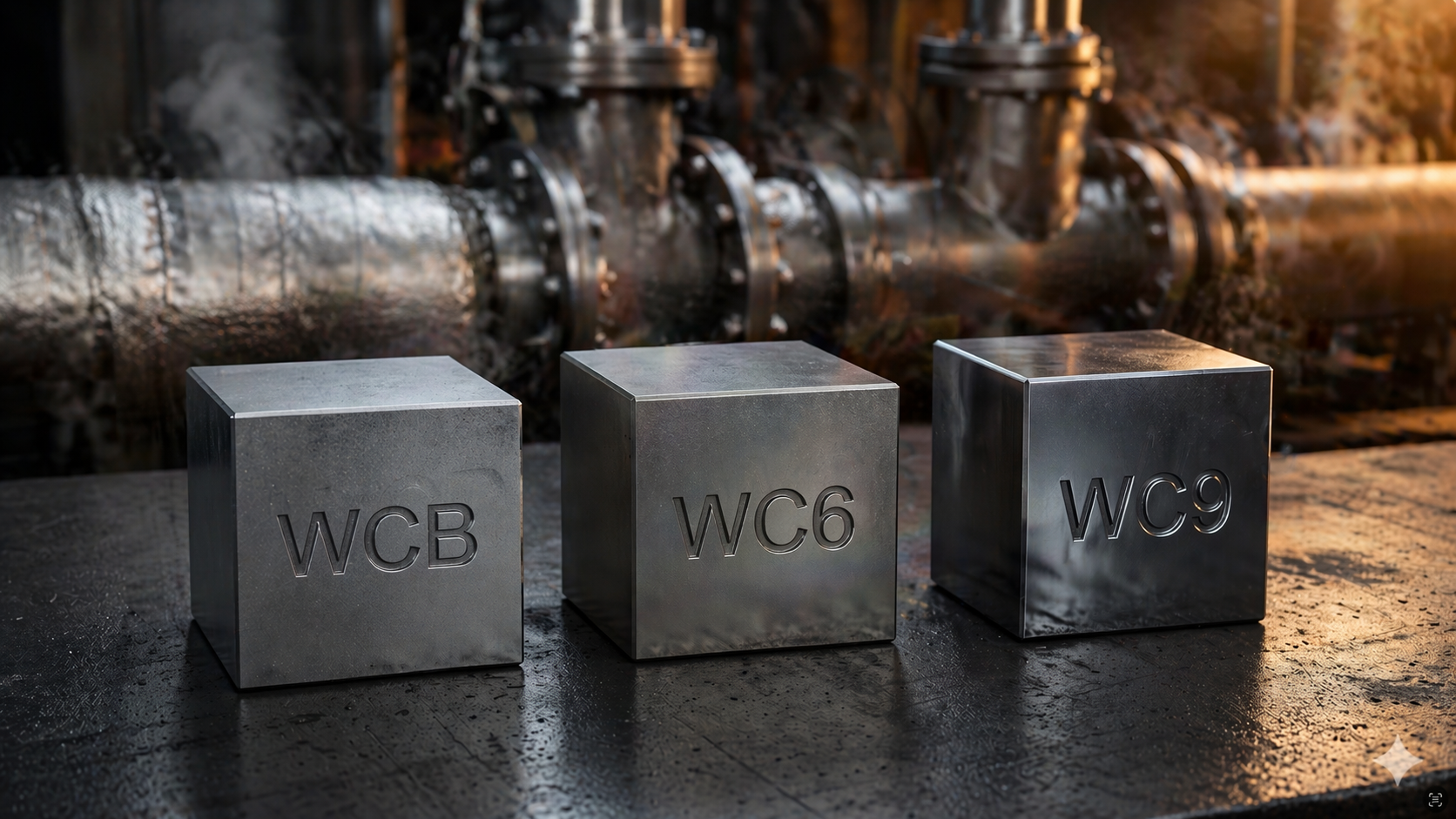
What WCB, WC6, and WC9 Actually Mean
All three are ASTM cast steel grades covered under ASTM A216 (WCB) and ASTM A217 (WC6 and WC9). The key difference is alloy content:
| Grade | ASTM Standard | Cr Content | Mo Content | Max Temperature |
|---|---|---|---|---|
| WCB | A216 | None | None | ~425°C |
| WC6 | A217 | 1.00–1.50% | 0.45–0.65% | ~540°C |
| WC9 | A217 | 2.00–2.75% | 0.90–1.20% | ~595°C |
Chromium improves oxidation resistance and high-temperature strength. Molybdenum improves creep resistance — the material’s ability to resist slow deformation under sustained load at elevated temperature. As both increase from WCB through WC6 to WC9, the material’s performance envelope at high temperature expands accordingly.
WCB — Carbon Steel, General Steam Service
WCB is the most widely used valve body material in industrial service globally. It offers good mechanical properties at ambient and moderate temperatures, straightforward machinability, and significantly lower cost than alloy steel grades.
For steam service, WCB is appropriate up to approximately 425°C. Below this threshold, it provides adequate creep resistance and oxidation performance for the majority of utility steam, heating steam, and lower-pressure process steam applications.
Above 425°C, WCB enters the creep range — the material begins to deform slowly under sustained mechanical stress. This is not a sudden failure; it is a gradual process that accumulates over years of operation. A valve body operating continuously above its material temperature limit will show progressive wall thinning and joint relaxation that is not detectable without specialist inspection.
Typical WCB applications in steam service:
- Saturated steam utility headers (below 425°C)
- Low and medium pressure steam distribution systems
- Plant heating steam networks
- Condensate return systems
WCB is not appropriate for main steam lines in power plants, boiler outlet connections, or any system where operating temperature approaches or exceeds 425°C.
WC6 — 1.25Cr-0.5Mo, Elevated Temperature Steam Service
WC6 adds chromium and molybdenum to the carbon steel base, pushing the practical temperature limit to approximately 540°C. The chromium content improves resistance to steam oxidation — the formation of oxide scale on internal surfaces — while the molybdenum addition strengthens grain boundaries against creep deformation.
WC6 is the standard specification for boiler outlet valves, intermediate steam headers, and power plant auxiliary steam systems operating in the 425–540°C range. It occupies the practical midpoint between the cost-effectiveness of WCB and the higher-alloy performance of WC9.
One important fabrication consideration: WC6 requires post-weld heat treatment (PWHT) after any welding operation, including field repairs and end connection welding during installation. PWHT relieves residual stresses introduced by welding that would otherwise accelerate cracking in service. This requirement adds time and cost to field modifications — a practical consideration when comparing WC6 against WCB for borderline temperature applications.
Typical WC6 applications:
- Boiler outlet steam lines (425–540°C range)
- Power plant auxiliary steam systems
- Refinery high-temperature process steam
- Steam turbine inlet isolation valves in medium-scale power applications
WC9 — 2.25Cr-1Mo, Severe Superheated Steam Service
WC9 doubles the chromium and molybdenum content compared to WC6, extending the temperature limit to approximately 595°C and providing superior creep rupture strength at the upper end of conventional steam service conditions. It is the standard material specification for main steam and hot reheat valves in conventional and supercritical power plants.
At 540°C and above, WC9 maintains significantly better long-term mechanical properties than WC6. The higher alloy content also provides improved resistance to hydrogen attack — a degradation mechanism relevant in refinery high-pressure hydrogen service, though less of a concern in pure steam applications.
WC9 carries a higher material cost than WC6 and imposes stricter PWHT requirements — preheat temperatures and PWHT soak temperatures are higher, and the process is less forgiving of procedure deviations. Over-specifying WC9 in applications where WC6 would perform adequately adds cost without engineering benefit.
Typical WC9 applications:
- Main steam isolation valves in power plants
- Hot reheat steam systems
- Superheated steam service above 540°C
- High-pressure high-temperature critical service valves
- Supercritical and ultra-supercritical boiler outlet connections
Pressure-Temperature Derating: Why Material Grade Affects More Than Temperature
A point that is frequently misunderstood in valve procurement: ASME B16.34 pressure-temperature ratings are material-specific. The allowable working pressure for a given pressure class decreases as temperature increases — and the derating curve differs between WCB, WC6, and WC9.
As a practical illustration for Class 600 valves at 500°C:
| Grade | Allowable Pressure at 500°C (approx.) |
|---|---|
| WCB | Not rated — exceeds temperature limit |
| WC6 | ~88 bar |
| WC9 | ~96 bar |
This means that at the same pressure class and the same operating temperature, a WC9 valve carries a higher allowable working pressure than a WC6 valve. In systems operating near the upper end of the WC6 temperature range, WC9 may provide meaningful additional pressure margin — relevant when considering future operating condition changes or design conservatism requirements.
Always verify pressure-temperature ratings against ASME B16.34 tables for the specific material group, not just the nominal pressure class designation.
PWHT Requirements — A Practical Fabrication Consideration
Both WC6 and WC9 require post-weld heat treatment after welding. This has practical implications for:
- End connection welding — butt weld end valves welded into the pipeline during installation require PWHT of the completed weld joint, adding time and specialist equipment to the installation programme
- Field repairs — any weld repair to a WC6 or WC9 valve body in service requires PWHT; cold repairs are not acceptable
- Procurement lead time — valve manufacturers must factor PWHT into production scheduling for alloy steel valves
WCB does not require PWHT for standard wall thicknesses, which simplifies both manufacturing and field installation. This is one of the practical reasons WCB remains the preferred specification for moderate-temperature service even when WC6 would technically perform adequately.
Choosing Between WCB, WC6, and WC9 — Decision Framework
| Operating Temperature | Recommended Grade | Rationale |
|---|---|---|
| Below 425°C | WCB | Adequate creep resistance, lower cost, no PWHT |
| 425°C – 540°C | WC6 | Required creep resistance, standard alloy steel spec |
| Above 540°C | WC9 | Higher creep strength, oxidation resistance for severe duty |
| Critical service with future uprate potential | WC9 | Additional pressure margin at temperature |
The most common specification error is using WCB in service conditions that periodically reach or exceed 425°C — particularly in systems where startup steam conditions briefly exceed normal operating temperature. If maximum design temperature is at or above 425°C, WC6 is the appropriate minimum specification.
Over-specifying is also a real cost concern: WC9 in a utility steam application below 400°C adds material cost and PWHT complexity with no engineering benefit.

HD Flowtech — Valve Supply in WCB, WC6, and WC9
HD Flowtech manufactures and supplies industrial valves in WCB, WC6, WC9, and stainless steel for steam systems, power plants, and high-temperature process applications.
We supply gate valves, globe valves, check valves, ball valves, and control valves with material certification to ASTM A216 and A217, full material traceability with heat number documentation, and pressure test certificates per API 598.
For alloy steel orders, we provide PWHT records and material test reports as standard — not on request.
Send us your valve datasheet or operating conditions — we’ll confirm the correct material grade and provide pricing.