
How to Choose the Right Plunger Valve: Engineering Selection Guide
TABLE OF CONTENTS
Packing type, body material, pressure class, and actuation — a practical plunger valve selection guide for engineers and industrial procurement teams.
Plunger valves are a specialised throttling and isolation valve type — less common than ball or gate valves, but the correct solution for a specific set of applications where precise flow control, high cycle life, and tight shutoff need to coexist in one valve. They work by driving a tapered or cylindrical plunger into a resilient sleeve or seat to restrict and shut off flow, giving them a throttling characteristic that most other valve types can’t match.
Choosing the wrong configuration — or substituting a ball valve where a plunger valve was specified — means poor throttling control, rapid seat wear, or a valve that can’t handle the cycling frequency of the application.
1. Confirm the Application Duty
Plunger valves are used in a narrower range of applications than general-purpose valve types. Before selecting configuration, confirm which duty applies:
Throttling and flow regulation is the core strength of the plunger valve. The tapered plunger entering the sleeve provides a progressive, controllable restriction across the full travel range — unlike a ball valve, which has a poor throttling characteristic at partial opening.
High-cycle isolation on instrument systems, chemical injection, and sampling lines. The plunger-and-sleeve design tolerates rapid repeated cycling better than soft-seated ball valves in the same service.
Low-flow and instrument isolation on pressure gauge connections, transmitter isolation, and analyser sample lines where a compact, reliable block valve is needed at small bore sizes.
Slurry and viscous fluid service where the wiping action of the plunger across the sleeve helps prevent solids from lodging in the seat — an advantage over ball and gate valves in dirty service.
If the application is straightforward on/off isolation at larger bore sizes with no throttling requirement, a plunger valve is not the right choice. Specify a ball or gate valve instead.
2. Pressure Class and Temperature
Plunger valves are most commonly available in Class 150 through Class 2500, with forged body construction standard at higher pressure classes. The same ASME B16.34 pressure-temperature relationship applies — allowable working pressure decreases with increasing temperature, and must be verified against the specific material grade, not assumed from nominal class alone.
Plunger valves are frequently specified at Class 800 and Class 1500 in instrument and chemical injection service, where small-bore forged construction is standard. Confirm the required pressure class against both normal operating conditions and any potential surge or upset pressures — instrument isolation valves in particular can see full system pressure on pump trip or pressure upset.
3. Body Material
Material selection follows the same logic as any process valve — fluid chemistry and temperature drive the decision.
Forged carbon steel (ASTM A105) — standard for oil, gas, and non-corrosive process service. The most common plunger valve body material in general industrial applications.
Forged stainless steel (ASTM A182 F316 / F316L) — for corrosive media, chemical injection service, and applications where carbon steel would corrode. Standard for instrument isolation in chemical and offshore service.
Duplex stainless steel — for chloride-containing environments and seawater service where 316SS is susceptible to pitting or stress corrosion cracking.
Alloy steel — for elevated temperature service where carbon steel creep resistance is insufficient.
Forged body construction is standard for plunger valves across most pressure classes — cast body plunger valves exist but are less common. Forged construction gives higher material integrity and tighter dimensional tolerances, which matters for the precise fit between plunger and sleeve.
4. Sleeve and Packing Material
The sleeve — the resilient element that the plunger seats against — determines sealing performance, temperature capability, and chemical compatibility. This is the most application-specific material selection in a plunger valve.
PTFE sleeve — standard for clean process fluids, instrument service, and chemical injection at moderate temperatures. Good chemical resistance across a wide range of media. Rated to approximately 200°C. The default choice for most plunger valve applications.
PEEK sleeve — for higher temperature service up to approximately 260°C, and for applications where PTFE creep under load would compromise seating over time.
Elastomer sleeve (EPDM, Buna-N, Viton) — for water service, low-pressure slurry, and applications requiring very low operating torque. Confirm elastomer compatibility with the specific fluid chemistry — EPDM and Viton have very different resistance profiles.
Metal seat configurations — available for high-temperature steam service and abrasive applications where resilient sleeves would wear rapidly. Less common than soft-sleeve designs and typically at higher cost.
Packing material — which seals the plunger stem — must also be specified. PTFE packing is standard for most service. Graphite packing for high-temperature applications. Live-loaded packing arrangements are available for fugitive emission compliance where required by environmental regulation.
5. End Connection and Body Pattern
Screwed (NPT or BSP) ends are the most common connection for plunger valves, reflecting their predominance in small-bore instrument and chemical injection service. Available in DN6 through DN50 in most catalogues.
Socket weld ends for small-bore high-pressure permanent piping where threaded connections are not acceptable.
Flanged ends for larger bore plunger valves in process piping applications.
Compression fitting ends for instrument tubing connections, particularly on analyser and sample system applications.
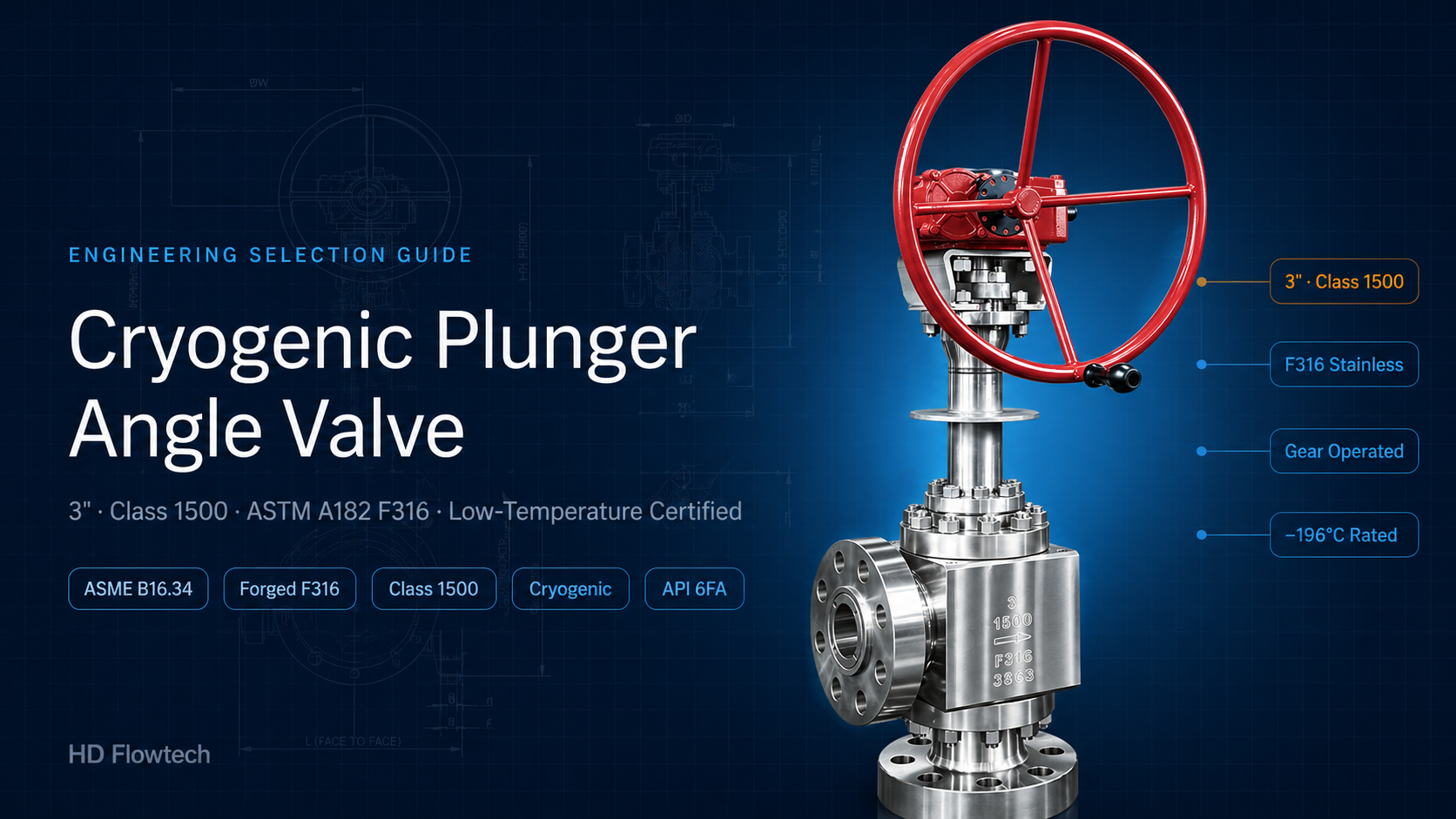
Body pattern — straight pattern (in-line flow) or angle pattern (90° flow turn) — should be selected based on the piping layout. Angle pattern plunger valves offer a natural flow direction change that can simplify instrument manifold arrangements, and also provide a slightly better throttling characteristic in some configurations.
6. Actuation
Most plunger valves in instrument and chemical injection service are manually operated — the small bore sizes and low operating forces involved make manual operation straightforward.
T-bar or handwheel — standard manual operators. T-bar for compact instrument installations; handwheel for larger bore sizes or where precise throttle positioning is required.
Lockable handles — available where valve position needs to be secured against inadvertent operation, common on chemical injection and sampling systems.
Pneumatic actuators — for automated plunger valves on chemical injection skids and remote-operated systems. Confirm actuator force against required seating load — plunger valves require axial force to seat the plunger into the sleeve, which is a different load characteristic to the quarter-turn torque of a ball valve.
Electric actuators — for modulating control duty where the plunger valve’s throttling characteristic is being used for flow regulation integrated with a control system.
7. Common Selection Mistakes
Substituting a ball valve for a plunger valve on throttling duty. A ball valve operated at partial opening concentrates erosion on a small section of the ball and seat — wear is rapid and shutoff degrades quickly. The plunger valve’s progressive restriction is designed for this duty.
Specifying the wrong sleeve material for the fluid chemistry. PTFE and elastomer sleeves have very different chemical resistance profiles. In chemical injection service particularly, confirm compatibility against the actual injection fluid — not just the carrier medium.
Ignoring packing specification on fugitive emission applications. Standard packing may not meet environmental emission requirements. Live-loaded packing or low-emission certified stem seals should be specified where regulations apply.
Using a threaded-end plunger valve in a high-vibration environment without thread locking or socket weld backup. Threaded connections are convenient but can work loose under vibration. On compressor skids and pump packages, socket weld construction is the safer specification.
Undersizing the actuator force on automated plunger valves. The axial seating load requirement increases with pressure class. Actuator selection must account for maximum differential pressure at closure, not just normal operating conditions.

HD Flowtech — Check Valve Supply and Technical Support
HD Flowtech supplies industrial plunger valves for chemical injection, instrument isolation, and process throttling applications — forged carbon steel and stainless steel construction, PTFE and PEEK sleeve configurations, screwed and socket weld ends, across Class 800 to 2500. Send us your pressure, temperature, fluid, and bore size. We’ll come back with the right specification and pricing.
RELATED ARTICLES
WCB vs WC6 vs WC9 Valve Materials: Engineering Guide for Steam Service
WCB, WC6, and WC9 valve body materials compared — temperature limits, chromium-molybdenum content, creep resistance, PWHT requirements, and steam service selection guidance for engineers.
How to Choose a Reliable Power Plant Valve Supplier for Saudi Arabia
How to choose a power plant valve supplier for Saudi Arabia — gate valves, globe valves, ASME standards, MTRs, and API 598 test certificates explained.
Common Valve Failures in Steam Lines: Causes, Prevention & Best Solutions
Seat leakage, thermal cracking, water hammer — the most common steam line valve failures explained, with material selection and engineering prevention guidance.
TABLE OF CONTENTS
RELATED ARTICLES
WCB vs WC6 vs WC9 Valve Materials: Engineering Guide for Steam Service
WCB, WC6, and WC9 valve body materials compared — temperature limits, chromium-molybdenum content, creep resistance, PWHT requirements, and steam service selection guidance for engineers.
How to Choose a Reliable Power Plant Valve Supplier for Saudi Arabia
How to choose a power plant valve supplier for Saudi Arabia — gate valves, globe valves, ASME standards, MTRs, and API 598 test certificates explained.
Common Valve Failures in Steam Lines: Causes, Prevention & Best Solutions
Seat leakage, thermal cracking, water hammer — the most common steam line valve failures explained, with material selection and engineering prevention guidance.