
Choosing the Right Butterfly Valve for Reliable Industrial Performance
TABLE OF CONTENTS
Wafer vs lug, concentric vs triple offset, EPDM vs metal seat — a practical butterfly valve selection guide covering body type, disc design, pressure class, materials, and actuation
Butterfly valves are one of the most widely used valve types in industrial piping — common in water treatment, HVAC, chemical processing, power generation, marine, and oil & gas service. Their quarter-turn operation, compact face-to-face dimensions, and relatively low weight make them a practical choice across an enormous range of line sizes and applications.
Simple to operate doesn’t mean simple to specify correctly. Butterfly valves span a wide range of disc designs, seat materials, pressure classes, and body configurations. Getting the specification wrong — particularly in steam service, corrosive chemical duty, or high-pressure hydrocarbon isolation — leads to seat failure, excessive operating torque, leakage, or valves that are not suitable for the actual service conditions.
This guide covers the key engineering decisions in butterfly valve selection, in the order that matters.
1. What Butterfly Valves Are Actually For
Before getting into selection details, it’s worth being clear on where butterfly valves belong — and where they don’t.
Butterfly valves are designed for on/off isolation and throttling service. When fully open, the disc remains in the flow path but is oriented parallel to the flow, producing relatively low pressure drop. This makes them well suited for large-diameter isolation on cooling water systems, pump suction and discharge headers, utility piping, and moderate-pressure process lines where compact installation and fast quarter-turn operation are valued.
Unlike gate valves, butterfly valves are also suitable for throttling. A butterfly valve can be held in an intermediate position to regulate flow, and with an appropriate actuator and positioner, can serve in modulating control applications. This dual capability — isolation and throttling in a single compact valve — is one of the main reasons butterfly valves are so widely specified.
What butterfly valves with soft seats are not designed for is high-temperature steam service. EPDM, NBR, and PTFE seats fail rapidly when exposed to steam above their temperature limits. Specifying a standard soft-seated butterfly valve on a steam line is one of the most common and costly field errors. For steam service, a metal-seated triple offset butterfly valve is the correct specification — or in some high-pressure power plant applications, a gate valve remains the better engineering choice.
Butterfly valves are also designed for frequent operation. Their quarter-turn action produces much lower stem and packing wear per cycle than the multi-turn operation of a gate valve, making them well suited for applications with regular cycling requirements.
2. Body Type Selection
The three standard butterfly valve body configurations differ primarily in how the valve connects to the pipeline and whether dead-end service is supported.
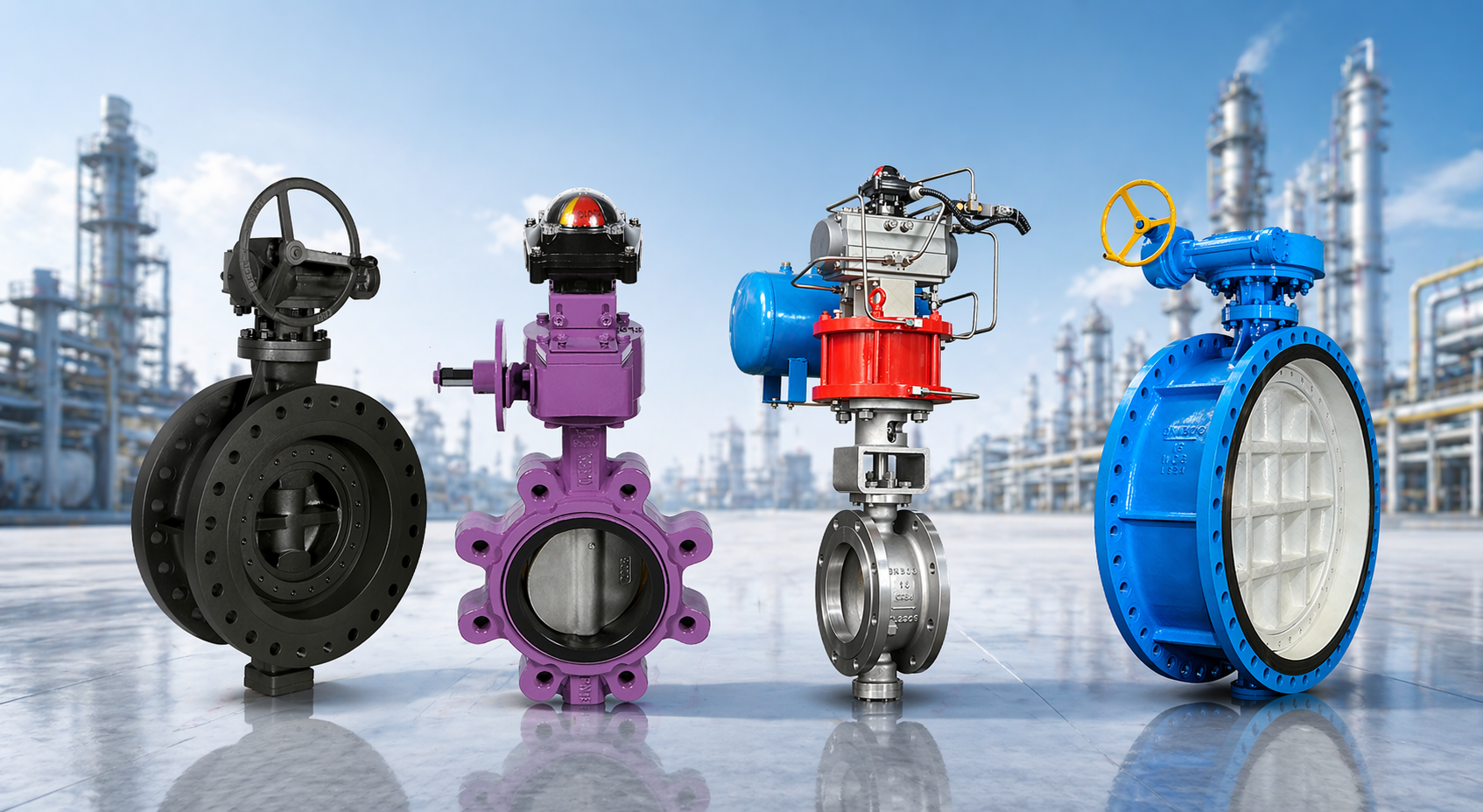
Wafer butterfly valve — installed between two pipeline flanges using through bolts that pass through the valve body and connect both flanges directly. The wafer design is the most compact and lowest-cost butterfly valve configuration. It is the standard choice for most water, HVAC, and general utility piping applications.
The limitation of a wafer butterfly valve becomes relevant when one side of the pipeline needs to be removed. With no threaded connections into the valve body itself, a wafer valve cannot support line pressure independently if the downstream flange is removed — the disc and seat are unsupported. Wafer valves are therefore not suitable for dead-end service.
Lug butterfly valve — the body includes threaded inserts (lugs) that accept bolts from each flange independently, rather than using through bolts. This allows one side of the pipeline to be disconnected while the valve remains in place and holding pressure on the other side. Lug butterfly valves are the correct specification wherever dead-end service is required — at the end of a pipeline, at maintenance isolation points, or where piping downstream of the valve may be disconnected during operation.
Note that lug butterfly valves in dead-end service are typically rated at a lower working pressure than in full bidirectional service — the manufacturer’s datasheet should be checked to confirm the dead-end pressure rating for the specific class and size.
Double-flanged butterfly valve — the body includes full flanges on both ends, providing the strongest mechanical support and the most precise face-to-face dimension compliance with standards such as ISO 5752 and EN 558. Double-flanged designs are standard for large-diameter transmission mains, pump stations, buried service, and applications where precise pipeline alignment and robust mechanical support are required.
3. Disc Design — Concentric, Double Offset, or Triple Offset
The disc design is the butterfly valve decision that most directly affects sealing performance, operating torque, service temperature capability, and suitability for the application.
Concentric butterfly valve — the stem passes through the centreline of both the disc and the pipe bore. The resilient elastomeric seat wraps the full circumference of the disc and remains in continuous contact with the disc throughout the operating stroke. This continuous contact provides a simple and effective seal for low-pressure water and HVAC service.
The limitation of a concentric design is the continuous seat friction. Every time the valve opens or closes, the disc edge rubs against the full circumference of the seat. In high-cycle service, this accelerates seat wear. The soft elastomeric seat also limits the temperature capability of the design — standard EPDM seats are limited to approximately 120°C, making concentric butterfly valves unsuitable for steam or elevated temperature process service.
Double offset butterfly valve — two geometric offsets move the stem behind the sealing plane and away from the pipe centreline. These offsets mean the disc lifts clear of the seat early in the opening stroke, rather than rubbing across the seat surface throughout the full rotation. This reduces operating torque significantly, extends seat life, and allows the use of higher-performance PTFE or fire-safe seat materials in place of simple elastomeric seats.
Double offset butterfly valves are the correct specification for industrial service with higher cycle counts, moderate-pressure process applications, and firewater systems where improved shutoff class and longer seat life are required compared with a concentric design.
Triple offset butterfly valve — a third offset — the cone angle of the sealing surface — creates a completely frictionless contact path. The disc geometry means it lifts completely clear of the seat with zero friction the instant it begins to open, and cams back into a single-point contact on closing. This produces a metal-to-metal bubble-tight seal with no seat degradation across millions of operating cycles.
Triple offset butterfly valves are the engineering-correct specification for high-temperature steam, refinery and hydrocarbon service, LNG, power plant applications, and any service requiring Class VI shutoff, fire-safe construction, or operating temperatures above 250°C. The metal-to-metal sealing geometry means there is no elastomeric or PTFE seat to fail — sealing performance does not degrade with temperature or service time.
Specifying a concentric or double offset soft-seated valve for service conditions that require a triple offset design is one of the most common butterfly valve specification errors in the field.
4. Seat Material Selection
Seat material selection follows operating temperature and fluid chemistry — in that order.
EPDM — the standard soft seat material for water, cooling systems, dilute chemical solutions, and general HVAC service. Temperature limit approximately 120°C. Not compatible with oils, hydrocarbons, or concentrated solvents. The most widely used butterfly valve seat material globally for water and utility service.
NBR (Nitrile) — for air service and applications with incidental oil or hydrocarbon traces. Temperature limit approximately 100°C. Not suitable for acids, hot water above 80°C, or ozone-rich environments. Less common in butterfly valves than EPDM but specified where oil resistance is required in a soft-seated design.
PTFE — for corrosive chemical service, solvents, acid lines, and food-grade applications where elastomeric seats are not chemically compatible. Temperature limit approximately 200°C. PTFE-seated butterfly valves are the standard specification in chemical plants for aggressive media at moderate temperatures.
Metal seat (Stellite or hardened stainless steel) — for steam service, high-temperature gas, abrasive media, hydrocarbons, and any application where a polymer or elastomeric seat would fail due to temperature or chemical attack. Metal-seated triple offset butterfly valves can operate continuously above 550°C and are the only butterfly valve design inherently suitable for fire-safe hydrocarbon service without a secondary seal arrangement.
A specific error that appears consistently in specifications: PTFE-seated butterfly valves specified for steam service. PTFE has a temperature limit of approximately 200°C and will creep and deform under steam at higher temperatures, destroying the seat seal. For steam service at any pressure, metal-seated triple offset designs are the correct specification.
5. Body Material Selection
Body material selection follows operating temperature, fluid chemistry, and mechanical requirements.
Cast iron (GG25) and ductile iron (GGG40/GGG50) — the standard body materials for water distribution, municipal infrastructure, and HVAC systems. Cost-effective, widely available, and suitable for the relatively benign service conditions typical of these applications. Ductile iron provides improved impact resistance and higher allowable stress compared to grey cast iron, and is now the preferred specification in most water supply and utility piping systems.
Carbon steel (ASTM A216 WCB) — the standard specification for general industrial service in oil and gas, utility steam, and process piping below approximately 425°C. The most widely used butterfly valve body material for industrial process service globally.
Stainless steel (ASTM A351 CF8M / CF3M) — for corrosive media, chemical process service, food and beverage, and marine applications where carbon steel corrosion would compromise valve performance or product purity. CF8M (316SS equivalent) is the standard specification for chemical plant service.
Alloy steel (WC6 / WC9) — for elevated temperature steam service in power generation. Above 425°C, carbon steel WCB enters the creep range. WC6 (1.25Cr-0.5Mo) and WC9 (2.25Cr-1Mo) maintain mechanical properties at higher temperatures and are the correct material specifications for butterfly valves in main steam and hot reheat service in power plants. As with gate valves in alloy steel, WC6 and WC9 require post-weld heat treatment (PWHT) after any installation welding — a practical consideration for butt weld end connections.
Duplex and super duplex stainless steel — for seawater, chloride-bearing streams, and offshore service where standard 316 stainless steel would suffer stress corrosion cracking or pitting. Specifying CF8M stainless for seawater butterfly valves is a common material selection error — duplex grades are the correct choice for chloride-rich service.
6. Pressure and Temperature Rating
Butterfly valve pressure ratings follow the same ASME B16.34 pressure-temperature relationship as gate valves — allowable working pressure decreases as operating temperature increases. Nominal pressure class is not the same as actual allowable pressure at elevated service temperature.
As a general guide:
PN10 / PN16 / Class 150 — low-pressure water systems, HVAC, municipal utilities, general utility piping. Soft-seated concentric or double offset designs are standard.
PN25 / PN40 / Class 300 — industrial process lines, moderate-pressure steam, firewater systems. Double offset designs with PTFE or fire-safe seats, or triple offset metal-seated valves.
Class 600 and above — high-pressure steam, refinery critical isolation, power plant service. Triple offset metal-seated designs are the engineering-correct specification at these pressure classes. Soft-seated butterfly valves are not appropriate for Class 600 and above in elevated temperature service.
A practical point that is often overlooked in butterfly valve specifications: soft-seated designs also derate at elevated temperatures. An EPDM-seated butterfly valve at the upper end of its temperature range has a reduced pressure rating compared with its nominal class. Always check the manufacturer’s pressure-temperature table for the specific seat material and body combination before finalising the specification.
7. End Connection
Wafer and lug (between-flange) — the standard end connection for most butterfly valve applications. Face-to-face dimensions to ISO 5752 short or long series, or ASME B16.10. No integral flanges on the valve body — the flanges are part of the pipeline.
Double-flanged — integral flanges to ASME B16.1, B16.5, or B16.47, depending on size and pressure class. Standard for large-diameter buried service and heavy industrial applications.
Butt weld ends — for permanent high-pressure piping where flanged connections are eliminated to reduce potential leak paths. Used on large triple offset butterfly valves in power plant and refinery critical service. Alloy steel butt weld end valves require PWHT after installation welding.
8. Actuation
Lever handle — standard for smaller butterfly valves in accessible locations at low operating torque. Provides direct visual indication of valve position. Suitable for DN50 to approximately DN150 in low-pressure water and HVAC service.
Gear operator (worm gear) — required for larger bore butterfly valves where manual torque would be impractical or unsafe, and for any valve that must be operated under significant differential pressure. A common specification error is selecting handwheel operation for a large-diameter butterfly valve without verifying that the available manual torque is sufficient to unseat the valve under maximum line pressure. A gear operator adds modest cost and is the correct specification for DN200 and above in most industrial service.
Pneumatic actuator — for automated on/off control and ESD service. Butterfly valves have a significant practical advantage over gate valves for pneumatic actuation: the quarter-turn operating angle requires a scotch-yoke or rack-and-pinion actuator rather than a multi-turn actuator, which reduces actuator size, cost, and response time. Specify fail-open or fail-closed spring return based on the process safety requirement.
Electric actuator — for remote operation, modulating throttling control, and applications where a compressed air supply is not available. Quarter-turn electric actuators are standard for butterfly valves — unlike the multi-turn actuators required for gate valves. Butterfly valves with electric positioners are widely used in flow control loops where moderate precision is acceptable.
Hydraulic actuator — for very high torque applications, large-diameter critical isolation valves, and offshore or subsea service where pneumatic torque output is insufficient.
9. Industry-Specific Considerations
Power plants — main steam and hot reheat butterfly valves are specified as Class 600 or 900, triple offset metal-seated, WC9 alloy steel or CF8C stainless body, butt weld ends. At the highest pressure and temperature conditions in supercritical plant, gate valves often remain the preferred specification for main steam isolation — butterfly valves at these conditions are specialist items requiring individual material certification and pressure testing documentation. For auxiliary steam, extraction, and feedwater service at moderate pressure, triple offset butterfly valves are increasingly used in place of gate valves for their reduced weight and faster actuation.
Oil and gas — API 609 governs design and testing for butterfly valves in oil and gas service. Fire-safe design to API 607 is required for hydrocarbon isolation duty. Double offset or triple offset metal-seated designs with appropriate fire-safe certification are standard. Soft-seated butterfly valves are not acceptable for hydrocarbon isolation in most oil and gas specifications.
Chemical plants — stainless steel or lined body designs for corrosive media. PTFE-seated butterfly valves in CF8M bodies are the standard for moderate-temperature acid and solvent service. Fugitive emission control — low-emission stem packing — is specified for volatile organic compound service. For highly aggressive media where stainless steel is not resistant, PTFE-lined butterfly valves with a carbon steel outer body are available.
Water and wastewater — ductile iron body, EPDM-seated concentric butterfly valves are the standard for water distribution and treatment service. Large-diameter double-flanged designs are used for pump station and transmission main isolation. For wastewater service with abrasive solids, double offset designs with higher-performance seating are preferred over standard concentric valves.
Marine and offshore — duplex or super duplex stainless steel body for seawater service. Double-flanged designs for structural rigidity in marine piping. Fire-safe certification required for hydrocarbon service. Hydraulic actuation is common for large critical isolation valves on offshore platforms.
10. Common Selection Mistakes
Specifying a soft-seated butterfly valve for steam service — the most damaging error in butterfly valve specification. EPDM and NBR seats fail rapidly above 120°C; PTFE seats fail above 200°C. Steam service at any pressure above these limits requires a metal-seated triple offset design. Using a standard concentric or double offset soft-seated valve on a steam line typically results in complete seat failure within one operating season.
Using a concentric design where a triple offset is required — concentric butterfly valves are the correct choice for water and HVAC service. They are not a cost-saving substitute for triple offset designs in industrial process, steam, or hydrocarbon service. The seating geometry of a concentric valve produces continuous seat contact under pressure, which causes unacceptable seat deformation at elevated temperatures and pressures. The result is rapid leakage development in service conditions the valve was not designed for.
Specifying WCB carbon steel for service above 425°C — the same creep threshold that applies to gate valves applies to butterfly valves. Above 425°C, WCB carbon steel enters the creep range and WC6 or WC9 alloy steel is required. Triple offset butterfly valves in power plant service at these temperatures require alloy steel or stainless steel body specification.
Using a wafer valve where dead-end service is required — a wafer butterfly valve cannot support full line pressure without downstream flange support. Specifying a wafer valve at a pipeline end or maintenance isolation point where the downstream piping may be removed is a systematic leak risk. Lug-type or double-flanged butterfly valves are the correct specification for dead-end service.
Undersizing the gear operator or actuator — butterfly valve operating torque at full differential pressure is significantly higher than running torque. For large-diameter valves or valves required to operate under full line pressure, the breakaway torque must be calculated and the actuator or gear operator selected with an appropriate safety factor (typically 1.25× to 1.5×). A handwheel or actuator that cannot generate sufficient torque to unseat the valve is a common operational problem that is straightforward to avoid at the specification stage.
Ignoring fire-safe requirements in hydrocarbon service — non-fire-safe butterfly valves fail catastrophically in a fire event when the soft seat burns away, leaving the valve unable to isolate the line. API 607 or ISO 10497 fire-tested butterfly valves must be specified for all oil, gas, and hydrocarbon pipeline applications. Triple offset metal-seated butterfly valves satisfy fire-safe requirements inherently — concentric and double offset soft-seated designs require specific secondary fire-seal construction to pass these tests.
Specifying stainless steel for seawater service — CF8M (316 stainless) is not resistant to pitting and stress corrosion cracking in seawater and chloride-rich environments. Duplex or super duplex stainless steel is the correct material specification for offshore, marine, and seawater service. Using standard stainless butterfly valves in seawater leads to rapid corrosion of the disc, body, and stem.

HD Flowtech — Butterfly Valve Supply and Technical Support
HD Flowtech manufactures and supplies industrial butterfly valves for power generation, oil and gas, chemical, water, and marine applications — concentric, double offset, and triple offset designs; wafer, lug, and double-flanged body configurations; ductile iron, carbon steel, stainless steel, alloy steel, duplex, and super duplex materials; EPDM, NBR, PTFE, and metal seat options; across PN10 to Class 900.
We review your system operating conditions and datasheets before recommending a specification — not after you’ve placed the order.
Send us your pressure class, temperature, fluid, bore size, and cycle frequency. We’ll come back with the right specification and pricing.
RELATED ARTICLES
WCB vs WC6 vs WC9 Valve Materials: Engineering Guide for Steam Service
WCB, WC6, and WC9 valve body materials compared — temperature limits, chromium-molybdenum content, creep resistance, PWHT requirements, and steam service selection guidance for engineers.
How to Choose a Reliable Power Plant Valve Supplier for Saudi Arabia
How to choose a power plant valve supplier for Saudi Arabia — gate valves, globe valves, ASME standards, MTRs, and API 598 test certificates explained.
Common Valve Failures in Steam Lines: Causes, Prevention & Best Solutions
Seat leakage, thermal cracking, water hammer — the most common steam line valve failures explained, with material selection and engineering prevention guidance.
TABLE OF CONTENTS
RELATED ARTICLES
WCB vs WC6 vs WC9 Valve Materials: Engineering Guide for Steam Service
WCB, WC6, and WC9 valve body materials compared — temperature limits, chromium-molybdenum content, creep resistance, PWHT requirements, and steam service selection guidance for engineers.
How to Choose a Reliable Power Plant Valve Supplier for Saudi Arabia
How to choose a power plant valve supplier for Saudi Arabia — gate valves, globe valves, ASME standards, MTRs, and API 598 test certificates explained.
Common Valve Failures in Steam Lines: Causes, Prevention & Best Solutions
Seat leakage, thermal cracking, water hammer — the most common steam line valve failures explained, with material selection and engineering prevention guidance.