
How to Choose the Right Gate Valve: Engineering Selection Guide
TABLE OF CONTENTS
Solid wedge vs flexible wedge, pressure-seal bonnet, WCB vs WC9 — a practical gate valve selection guide covering materials, pressure class, bonnet design, and common specification mistakes
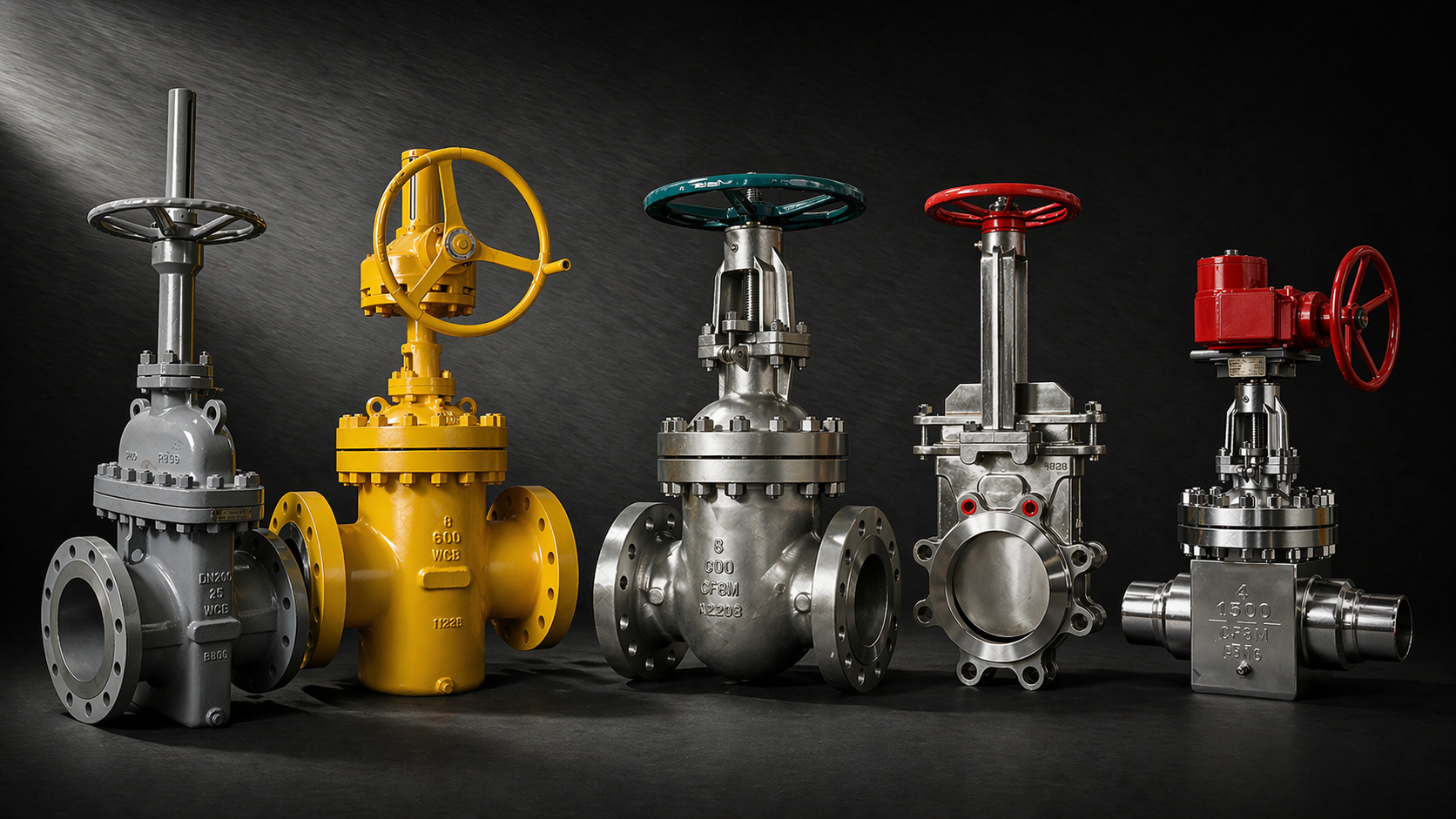
Gate valves are one of the oldest and most straightforward valve designs in industrial service — and still one of the most widely used for isolation duty in power plants, refineries, chemical plants, and water infrastructure. The operating principle is simple: a wedge or gate moves perpendicular to the flow path to open or close the line.
Simple in principle doesn’t mean simple to specify correctly. Gate valves span an enormous range of pressure classes, materials, wedge designs, and bonnet configurations. Getting the specification wrong — particularly in high-temperature steam service or high-pressure critical applications — leads to problems that show up as leakage, difficult operation, or shortened service life.
This guide covers the key engineering decisions in gate valve selection, in the order that matters.
1. What Gate Valves Are Actually For
Before getting into selection details, it’s worth being clear on where gate valves belong in a system — and where they don’t.
Gate valves are designed for full open or full closed isolation service. When fully open, the gate retracts completely out of the flow path, leaving a full-bore opening with minimal pressure drop. This makes them well suited for large-bore isolation on main pipelines, steam headers, and utility systems where pressure drop across the valve matters.
What gate valves are not designed for is throttling. If a gate valve is operated in a partially open position for flow regulation, the high-velocity flow across the partially exposed wedge face causes wire drawing — erosion of the seating surfaces that progressively destroys shutoff capability. A gate valve used for throttling typically loses its sealing integrity within one operating season. If your application requires flow regulation, specify a globe valve instead.
Gate valves are also designed for infrequent operation. Unlike ball valves, which are well suited to frequent cycling, gate valves in high-cycle service accumulate wear on the stem threads and packing more rapidly. For frequent operation duty, consider whether a ball valve or butterfly valve would be a better fit.
2. Pressure Class Selection
Gate valve pressure class follows ASME B16.34 for cast and forged steel, with allowable working pressure decreasing as temperature increases — the pressure-temperature derating effect. Nominal pressure class is not the same as actual allowable pressure at elevated temperature.
As a general guide:
- Class 150 / PN16–25 — low pressure utility systems, water service, general plant piping below 260°C
- Class 300 / PN40–50 — medium pressure plant and process service
- Class 600 — higher pressure steam, oil, and gas service; pressure-seal bonnet typically specified at this class and above
- Class 900 to 2500 — critical high-pressure service including main steam lines in power plants, high-pressure gas pipelines, and refinery critical isolation
A specific example that catches people out: a WCB carbon steel gate valve rated Class 600 has an allowable working pressure of approximately 102 bar at 38°C, but this drops to around 73 bar at 400°C. If your system operates at 80 bar and 400°C, a Class 600 WCB gate valve is undersized for the service condition. Always check ASME B16.34 pressure-temperature tables for the specific material group before finalising specifications.
3.Body Material Selection
Material selection in gate valves follows operating temperature, fluid chemistry, and creep resistance requirements — in that order of priority.
Carbon steel (ASTM A216 WCB / A105 forged) — the standard specification for general industrial service up to approximately 425°C. Suitable for steam, water, oil, and non-corrosive process media. The most widely used gate valve body material globally.
Chrome-moly alloy steel (ASTM A217 WC6 — 1.25Cr-0.5Mo) — for elevated temperature service up to approximately 540°C. Above 425°C, carbon steel enters the creep range — WC6 maintains mechanical properties through the addition of chromium and molybdenum. Standard specification for boiler outlet gate valves and intermediate steam header isolation in power plants.
Higher chrome-moly alloy steel (ASTM A217 WC9 — 2.25Cr-1Mo) — for severe high-temperature service up to approximately 595°C. The higher alloy content provides superior creep resistance compared to WC6 at the upper end of conventional steam service conditions. Standard for main steam isolation valves in large power plants and supercritical boiler applications.
Low-temperature carbon steel (ASTM A352 LCB / LCC) — for cryogenic and low-temperature service where standard carbon steel would become brittle. Impact tested at -46°C or lower.
Stainless steel (ASTM A351 CF8M / CF3M) — for corrosive media, chemical process service, and applications where carbon steel corrosion would compromise valve performance or product purity.
Duplex stainless steel — for chloride-containing environments and seawater service where standard 316SS would suffer stress corrosion cracking or pitting.
Both WC6 and WC9 require post-weld heat treatment (PWHT) after any welding — including field installation welding of butt weld end connections. This adds time and specialist equipment to installation. It’s a practical consideration when comparing WC6 against WCB for borderline temperature applications.
4. Wedge Design — Solid, Flexible, or Parallel Slide
The wedge design is the gate valve decision that most directly affects sealing performance and suitability for thermal cycling service.
Solid wedge gate valves are the most common design for general industrial service. The wedge is a single rigid casting or forging machined to match the seat rings. Simple, robust, and cost-effective for stable temperature service where thermal distortion of the body is not a concern.
The limitation of a solid wedge becomes apparent in steam service. When a hot steam line is shut down and the valve body cools, the body contracts slightly around the solid wedge. When the system is restarted, the contracted body can grip the wedge tightly enough that the valve becomes extremely difficult or impossible to open — a phenomenon known as thermal binding. This is a common maintenance issue in steam plants where solid wedge gate valves are incorrectly specified.
Flexible wedge gate valves address the thermal binding problem by introducing a degree of flexibility into the wedge — either a groove cut into the wedge face, or a flexible connection between the two seat faces. This allows the wedge to accommodate minor thermal distortion of the body without losing sealing contact on closure or becoming thermally bound on opening.
For steam service — particularly in systems with regular startup and shutdown cycles — flexible wedge designs are the engineering-correct specification. Solid wedge gate valves in steam service are a common specification error.
Parallel slide gate valves use two parallel gate plates with a spring between them, rather than a tapered wedge. The sealing force comes from line pressure acting on the upstream gate, not from wedging action. This makes them particularly well suited to high-pressure main steam applications where wedge-type designs can suffer from the compounding effects of high seat contact stress and thermal distortion. Parallel slide designs are standard on main steam isolation valves in many large power plants
5. Bonnet Design — Bolted vs Pressure Seal
The bonnet is the pressure-containing closure at the top of the valve body, through which the stem passes. Bonnet design affects both sealing reliability and suitability for high-pressure service.
Bolted bonnet is the standard design for Class 150 through Class 300, and is commonly used up to Class 600 in moderate temperature service. The bonnet is sealed by a gasket compressed by bonnet bolting. The limitation is bolt relaxation — at elevated temperatures, bolts lose preload over time as the material creeps, reducing gasket compression and eventually leading to bonnet joint leakage. Regular bolt retorquing during maintenance is required to manage this.
Pressure seal bonnet is the standard specification for Class 600 and above in high-temperature service. The design works on a counterintuitive principle: the bonnet seal is loaded by internal pressure rather than bolt preload. As system pressure increases, sealing force on the bonnet gasket increases proportionally — the valve becomes more leak-tight as pressure rises, rather than less. This eliminates the bolt relaxation problem and is why pressure seal bonnet designs are the engineering standard for power plant main steam gate valves at Class 900 and above.
The trade-off is that pressure seal bonnets are more complex to assemble and disassemble during maintenance. For lower pressure classes where bolt relaxation is not a concern, the simplicity of a bolted bonnet is appropriate.
6. End Connection
Flanged ends (ASME B16.5 / B16.47) — standard for most plant piping applications. Removable for maintenance and inspection. Available in all pressure classes and bore sizes.
Butt weld ends — for permanent high-pressure piping where flanged joints are eliminated to reduce potential leak paths. Standard for large-bore high-pressure steam and gas pipelines. Requires PWHT for alloy steel grades after installation welding.
Socket weld ends — for small-bore high-pressure lines, typically DN50 and below, where butt welding is impractical but a permanent connection is preferred over flanged.
Threaded ends — for small-bore utility and instrument connections at lower pressure classes.
7. Stem Design — Rising vs Non-Rising
This is a selection consideration that doesn’t always get adequate attention.
Outside screw and yoke (OS&Y) rising stem — the stem rises visibly as the valve opens, providing a clear visual indication of valve position. The stem threads are outside the flow medium, so they’re not exposed to corrosion or contamination from the process fluid. Standard for most industrial gate valves in accessible locations.
Non-rising stem — the stem rotates but does not rise, with the stem threads inside the valve body. Suitable for buried service or space-constrained installations where stem travel clearance is not available. The limitation is that stem threads are exposed to the process fluid — in corrosive or contaminated service, this accelerates stem thread wear.
For underground or buried gate valves in water supply and wastewater systems, non-rising stem designs with extension spindles are standard. For above-ground plant piping, OS&Y rising stem is almost universally specified.
8. Actuation
Handwheel — standard for smaller bore gate valves in accessible locations. Gate valves require multiple turns to open and close — unlike the quarter-turn of a ball valve — so handwheel operation is slower by nature.
Gear operator (bevel gear or worm gear) — required for larger bore valves where handwheel torque would be impractical, and for valves that need to be operated under high differential pressure. A common mistake is specifying handwheel operation for a large gate valve without checking whether the operator can actually generate enough torque to unseat the valve under maximum line pressure.
Electric actuator — for remote operation, automated control, or valves in inaccessible locations. Multi-turn electric actuators are standard for gate valves — unlike quarter-turn actuators used for ball and butterfly valves.
Pneumatic actuator — for automated shutdown service and ESD applications where fast operation is required. Gate valves are inherently slower to operate than ball valves due to the multi-turn requirement, which limits their suitability for very fast ESD duty.
9. Industry-Specific Considerations
Power plants — main steam and hot reheat gate valves are typically specified as Class 900 or 1500, WC9 alloy steel, flexible wedge or parallel slide, pressure seal bonnet, butt weld ends. These are not catalogue items — they require individual material certification and pressure testing documentation.
Oil and gas — API 600 is the standard governing design and testing requirements for bolted bonnet steel gate valves in oil and gas service. Fire-safe design to API 607 may be required for hydrocarbon isolation duty.
Chemical plants — stainless steel or alloy materials required for corrosive media. Fugitive emission control — low-emission stem packing — is increasingly specified for volatile organic compound service.
Water and wastewater — large bore resilient-seated gate valves (soft seat, ductile iron body) for buried water supply service; metal-seated designs for higher pressure or abrasive service.
10. Common Selection Mistakes
The same errors appear consistently across gate valve specifications.
Using a gate valve for throttling service — the most common mistake in the field. Wire drawing destroys the seat surfaces rapidly. If partial flow control is required, specify a globe valve.
Specifying WCB carbon steel for service above 425°C — or for systems where operating temperature periodically exceeds this limit during startup. Above the WCB creep threshold, WC6 or WC9 is required.
Specifying a solid wedge for steam service with regular startup and shutdown cycles — thermal binding is a predictable consequence. Flexible wedge or parallel slide designs exist precisely to solve this problem.
Using a bolted bonnet at Class 600 and above in high-temperature service without accounting for bolt relaxation — pressure seal bonnet construction is the engineering-correct choice at these conditions.
Specifying handwheel operation for a large bore high-pressure gate valve without checking whether operating torque is achievable — a gear operator adds modest cost but eliminates a real operational problem.

HD Flowtech — Gate Valve Supply and Technical Support
HD Flowtech manufactures and supplies industrial gate valves for power generation, oil and gas, chemical, and general process applications — solid wedge, flexible wedge, and parallel slide designs; bolted and pressure seal bonnets; carbon steel, alloy steel, stainless steel, and duplex materials; across ASME Class 150 to 2500.
We review your system operating conditions and datasheets before recommending a specification — not after you’ve placed the order.
Send us your pressure class, temperature, fluid, and bore size. We’ll come back with the right specification and pricing.
RELATED ARTICLES
WCB vs WC6 vs WC9 Valve Materials: Engineering Guide for Steam Service
WCB, WC6, and WC9 valve body materials compared — temperature limits, chromium-molybdenum content, creep resistance, PWHT requirements, and steam service selection guidance for engineers.
How to Choose a Reliable Power Plant Valve Supplier for Saudi Arabia
How to choose a power plant valve supplier for Saudi Arabia — gate valves, globe valves, ASME standards, MTRs, and API 598 test certificates explained.
Common Valve Failures in Steam Lines: Causes, Prevention & Best Solutions
Seat leakage, thermal cracking, water hammer — the most common steam line valve failures explained, with material selection and engineering prevention guidance.
TABLE OF CONTENTS
RELATED ARTICLES
WCB vs WC6 vs WC9 Valve Materials: Engineering Guide for Steam Service
WCB, WC6, and WC9 valve body materials compared — temperature limits, chromium-molybdenum content, creep resistance, PWHT requirements, and steam service selection guidance for engineers.
How to Choose a Reliable Power Plant Valve Supplier for Saudi Arabia
How to choose a power plant valve supplier for Saudi Arabia — gate valves, globe valves, ASME standards, MTRs, and API 598 test certificates explained.
Common Valve Failures in Steam Lines: Causes, Prevention & Best Solutions
Seat leakage, thermal cracking, water hammer — the most common steam line valve failures explained, with material selection and engineering prevention guidance.