
Floating vs trunnion, soft seat vs metal seat, ASME pressure class, body material — a practical ball valve selection guide for engineers and industrial procurement teams.
Ball valves are one of the most widely used valve types in industrial piping — oil and gas, chemical plants, power generation, water treatment, LNG, and general utility service all rely on them for fast quarter-turn isolation and low pressure drop. But “ball valve” covers an enormous range of designs, materials, and pressure classes. Choosing the wrong one for the application doesn’t just mean suboptimal performance — it can mean valve failure, seat damage, or an actuator that can’t generate enough torque to operate the valve under line pressure.
This guide covers the key engineering decisions in ball valve selection, in the order you should actually make them.
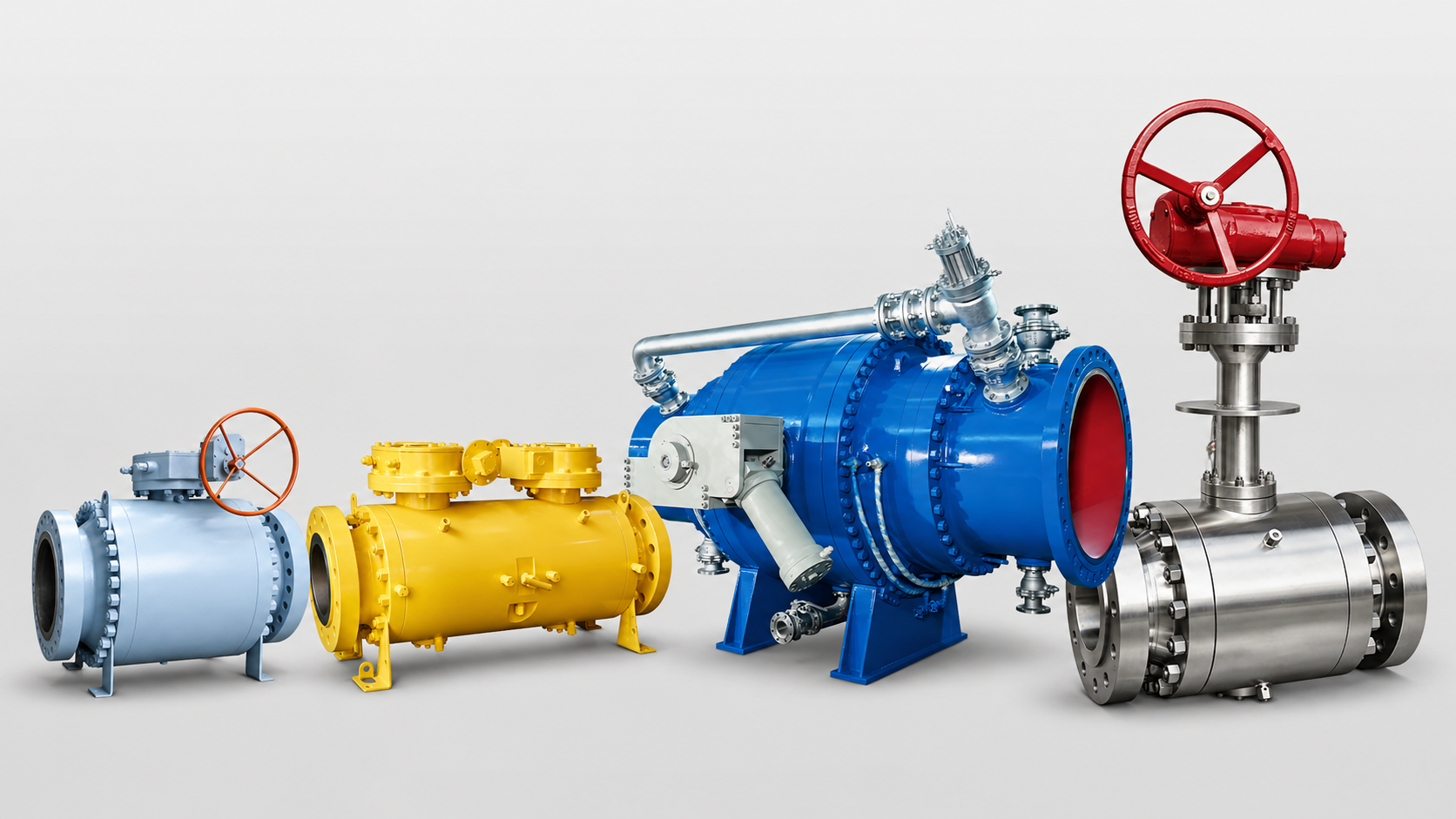
1. Start with Operating Conditions — Pressure, Temperature, and Fluid
Before anything else, you need the actual process data:
- Operating pressure and design pressure (bar g or psi g)
- Normal operating temperature and maximum design temperature (°C)
- Fluid type — clean gas, liquid, slurry, corrosive media, cryogenic, or steam
- Cycling frequency — occasional isolation, continuous throttling, or frequent operation
These four pieces of information drive every other selection decision. A ball valve for clean water service at PN16 is a fundamentally different product to one for high-pressure sour gas service at Class 900 — even if they’re the same bore size.
2. Pressure Class Selection
Ball valve pressure class follows ASME B16.34 for carbon and alloy steel, or equivalent standards for other materials. The key point that’s frequently misunderstood: pressure class is not a fixed pressure rating — allowable working pressure decreases as temperature increases.
As a general guide:
- Class 150 / PN16–25 — low pressure utility systems, water service, general plant piping
- Class 300 / PN40–50 — medium pressure industrial and process service
- Class 600 — higher pressure process and pipeline applications
- Class 900 to 2500 — critical high-pressure service, including high-pressure gas, steam, and subsea applications
Always verify the actual pressure-temperature rating for the specific material grade against ASME B16.34 tables — don’t rely on nominal class alone.
3. Floating Ball vs Trunnion Mounted — This Decision Matters More Than Most Buyers Realise
This is probably the most important structural decision in ball valve selection, and the one most frequently made incorrectly on cost grounds.
Floating ball valves have the ball supported by the two seat rings, with no fixed shaft bearings. Under line pressure, the upstream seat pushes the ball against the downstream seat to create the seal. This works well for smaller bore sizes and lower pressure classes — but as bore size and pressure class increase, the seat load generated by line pressure becomes excessive, causing accelerated seat wear and high operating torque.
Trunnion mounted ball valves have the ball fixed to upper and lower trunnion shafts, with independent spring-loaded seats that maintain sealing contact regardless of line pressure. This removes the pressure-driven seat loading problem — operating torque is consistent across the pressure range, and seat wear is significantly reduced in high-cycle applications.
As a practical guide: floating ball valves are appropriate for DN50 and below at Class 150–300, and up to DN100 at Class 150 in general service. Above these thresholds — or for critical isolation duty at any size — trunnion mounted designs are the engineering-correct choice, not just a premium option.
For Class 600 and above, trunnion mounted is standard specification regardless of bore size.
4. Body and Trim Material Selection
Material selection follows the fluid chemistry and operating temperature — not budget alone.
Carbon steel (ASTM A216 WCB / A105 forged) — standard for oil, gas, steam, and non-corrosive process media up to approximately 425°C. The most common ball valve body material in industrial service.
Low-temperature carbon steel (ASTM A352 LCB / A350 LF2) — required for cryogenic and low-temperature service below -29°C, where standard carbon steel becomes brittle. LNG, liquid nitrogen, and cryogenic process applications.
Stainless steel (ASTM A351 CF8M / CF3M — 316/316L) — for corrosive media, chemical service, and applications where carbon steel would corrode. CF8M for standard stainless service; CF3M where post-weld heat treatment needs to be avoided.
Duplex stainless steel — for chloride-containing environments, seawater service, and applications where standard 316SS would suffer pitting or stress corrosion cracking. Coastal installations, offshore service, and seawater cooling systems.
Alloy steel (ASTM A217 WC6/WC9) — for high-temperature steam service above 425°C where carbon steel creep resistance is inadequate. Less common in ball valves than in gate and globe valves, but specified for high-temperature utility ball valves in power plant applications.
5. Seat Material — Soft Seat vs Metal Seat
Seat material determines sealing performance, temperature capability, and service life.
Soft seats (PTFE, RPTFE, PEEK, Devlon) provide bubble-tight shutoff and are the standard choice for clean media at moderate temperatures. PTFE seats are rated to approximately 200°C; PEEK and Devlon extend this to around 250–260°C. Soft seats are not appropriate for abrasive media, high-velocity steam, or applications where thermal cycling causes the seat material to deform.
Metal seats (Stellite hardfaced, tungsten carbide coated) are required for high-temperature service above soft seat limits, abrasive media such as sand-laden fluids, high-velocity steam, and applications where fire safety requires the valve to maintain shutoff after a soft seat has been compromised. Metal seats don’t provide the same initial leak tightness as soft seats, but they maintain performance in conditions that would rapidly destroy PTFE.
For fire-safe service in oil and gas applications, ball valves should be specified to API 607 or API 6FA — these standards verify that the valve maintains acceptable leakage after exposure to fire conditions that would destroy the primary soft seat.
6. Full Bore vs Reduced Bore
This is a selection decision that gets overlooked more often than it should.
A full bore (full port) ball valve has a ball bore diameter equal to the internal pipe diameter. Flow passes through without restriction, pressure drop across the valve is minimal, and the valve can be pigged — meaning cleaning or inspection tools can pass through the pipeline without obstruction.
A reduced bore (standard port) ball valve has a ball bore smaller than the pipe internal diameter, typically one pipe size smaller. This creates a measurable pressure drop across the valve and prevents pigging, but the valve is physically smaller, lighter, and less expensive than a full bore equivalent at the same pressure class and end connection size.
The practical selection rule: specify full bore where pigging is required, where pressure drop across the valve is a system design constraint, or where flow velocity through a reduced bore would cause erosion or cavitation. Specify reduced bore where none of these apply — the cost saving is real and there’s no engineering penalty.
In pipeline service, full bore is almost always specified as a default. In plant piping, reduced bore is often acceptable and frequently preferred on cost grounds. The mistake is specifying full bore across an entire plant scope without checking whether it’s actually needed at each location.
7. Double Block and Bleed (DBB)
Double block and bleed is a valve configuration — or a single valve design — that provides two independent seating surfaces with a bleed port between them, allowing the cavity between the seats to be vented or drained to confirm isolation integrity.
In a standard ball valve used for single isolation, you have one sealing surface. If that surface leaks, there’s no way to verify isolation without depressurising the line. In a DBB configuration, you have two independent seats — if the upstream seat is leaking into the cavity, you can detect it by monitoring the bleed port, and the downstream seat still provides isolation.
DBB valves are specified in oil and gas applications where positive isolation needs to be verified before maintenance work — instrument connections, chemical injection points, sampling systems, and anywhere that a single valve failure would expose maintenance personnel to line pressure or hazardous media. They’re also required by process safety management systems in many jurisdictions as a substitute for physical spade isolation in certain circumstances.
A single-valve DBB design — where both seating functions are achieved within one valve body — is more compact than two separate valves with a bleed valve between them, and is increasingly specified in offshore and space-constrained onshore applications.
8. End Connection
End connection selection follows the piping system design and pressure class:
Flanged ends (ASME B16.5 / B16.47) are the most common configuration for plant piping — removable for maintenance, standard across all pressure classes and bore sizes.
Butt weld ends are used for high-pressure permanent piping where flanged joints are avoided to reduce potential leak paths. Common in pipeline and high-pressure process systems.
Socket weld ends are standard for small-bore high-pressure lines — typically DN50 and below — where butt welding is impractical but a permanent connection is required.
Threaded ends for very small bore instrument and utility connections, typically DN25 and below at lower pressure classes.
9. Actuation
Actuation selection follows operating requirements — how fast does the valve need to operate, how often, and from where:
Manual lever — standard for DN50 and below in easily accessible locations. Quarter-turn operation is fast and straightforward.
Gear operator (worm gear or bevel gear) — required for larger bore valves where lever torque would be impractical, and for precise positioning. Provides mechanical advantage but slower operation than a lever.
Electric actuator — remote or automated operation, programmable open/close timing, position feedback to DCS or SCADA. Required for valves in inaccessible locations or integrated into automated systems.
Pneumatic actuator — fast operation for automated shutdown service, ESD (emergency shutdown) applications, and high-cycle duty. Requires instrument air supply. Fail-safe spring-return pneumatic actuators are standard for ESD valves.
Hydraulic actuator — for very large bore or high-torque applications where pneumatic actuators cannot generate sufficient force, and for subsea applications.
For all actuated ball valves, torque calculation needs to account for maximum differential pressure at the time of valve operation — not just normal operating conditions.
10. Industry-Specific Requirements
Oil and gas — fire-safe certification (API 607/6FA), anti-static design, sour service compliance (NACE MR0175/ISO 15156) for H₂S-containing fluids. These are qualification requirements, not just performance preferences.
Chemical plants — corrosion-resistant body and trim materials matched to the specific fluid chemistry. PTFE-lined designs for aggressive acids and caustics where metallic contact needs to be eliminated entirely.
Power plants — high-temperature service ball valves for steam and high-temperature condensate; metal seats standard; pressure class matched to system design pressure.
Water treatment — corrosion-resistant materials for chlorinated water and chemical dosing service; rubber-lined or stainless steel construction for slurry and sludge handling.
LNG and cryogenic — low-temperature certified body and trim materials; extended bonnet designs to keep the stem packing away from cryogenic temperatures; cryogenic testing per BS 6364 or equivalent.
11. Anti-Static Design
In flammable fluid service, electrostatic charge can accumulate on the ball and stem during valve operation — particularly in gas service where fast-moving molecules transfer charge through contact with the valve internals. If this charge builds up without a discharge path, it can arc across insulating seat materials and ignite flammable media.
Anti-static design provides a continuous electrical continuity path between the ball, stem, and valve body through spring-loaded conductive pins or balls. This ensures that any accumulated charge dissipates safely through the valve body to the pipeline system, rather than arcing across the seat.
API 608 and API 6D both include anti-static requirements for ball valves in hydrocarbon service. Testing involves verifying that electrical resistance between ball, stem, and body does not exceed 10 ohms. This is not a complex design feature — but it needs to be specified and verified, not assumed.
For fire-safe service, anti-static design is typically required alongside API 607 or API 6FA certification. The two requirements address different failure modes: fire-safe certification addresses what happens after the soft seat burns away; anti-static design addresses ignition prevention during normal operation.
12. Body Cavity Pressure Relief
Ball valves have an enclosed cavity between the ball and the body when the valve is in the closed position. In liquid service, if this cavity is filled with liquid and the valve is then exposed to heat — solar radiation on an above-ground pipeline, process fluid warming after shutdown, or fire exposure — the trapped liquid expands and pressure in the cavity rises.
In a standard ball valve, if cavity pressure exceeds seat differential pressure rating, the seats can be forced open, causing uncontrolled leakage from both ends of the closed valve simultaneously. This is particularly relevant for liquid hydrocarbon service, cryogenic systems where liquid boil-off generates gas pressure, and any application where the valve may be left closed in a warm environment.
Body cavity relief is addressed in two ways. Self-relieving seats — typically used in trunnion mounted designs — are designed to lift off the ball when cavity pressure exceeds a set differential, venting excess pressure to the upstream side of the pipeline rather than through both seats. Body cavity relief valves — small integral pressure relief valves built into the body — vent excess cavity pressure to atmosphere or to a collection system.
Specifications for body cavity relief requirements should be reviewed for any ball valve application involving liquid hydrocarbons, cryogenic fluids, or elevated temperature service. API 6D addresses body cavity relief requirements for pipeline ball valves — if your application is governed by API 6D, cavity relief needs to be part of the specification review.
13. Common Selection Mistakes
After working across these applications, the same errors come up repeatedly.
Specifying a floating ball valve for a large-bore high-pressure application because it’s cheaper — and ending up with a valve that requires excessive torque to operate and wears out its seats quickly.
Using standard carbon steel in a mildly corrosive service where stainless steel was specified for a reason — and experiencing accelerated corrosion that voids any cost saving within the first operating season.
Selecting a soft-seated valve for a high-temperature steam application, or for service where fire-safe certification is required — neither of which PTFE seats are designed to handle.
Sizing the actuator against normal operating conditions only, without checking whether the valve can actually be operated under maximum differential pressure at startup or shutdown.
Specifying full bore across an entire plant scope by default, without reviewing whether reduced bore would perform equally well at lower cost.
Missing the body cavity relief requirement on a liquid hydrocarbon application, and discovering the problem only when seats are forced open by thermal expansion in a closed valve.

HD Flowtech — Ball Valve Supply and Technical Support
HD Flowtech manufactures and supplies industrial ball valves for power generation, oil and gas, chemical, and general process applications — floating and trunnion mounted designs, soft seat and metal seat configurations, in carbon steel, stainless steel, duplex, and alloy steel, across ASME Class 150 to 2500.
We review your operating conditions and system datasheet before recommending a specification — not after you’ve placed the order.
Send us your pressure, temperature, fluid, and bore size. We’ll come back with the right specification and pricing.